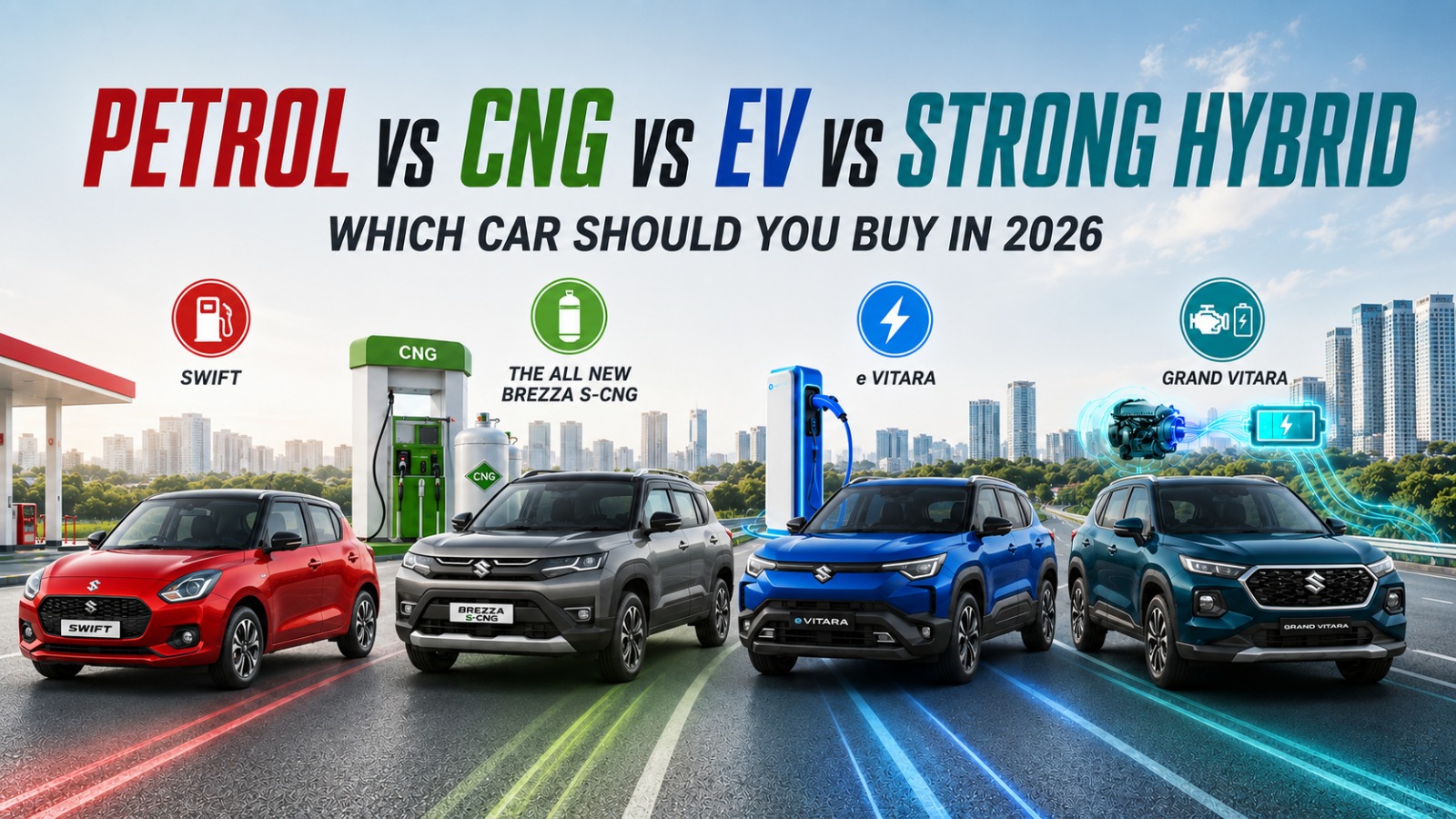
CNG Car Advantages and Disadvantages: Mileage, Boot Space, Performance and Refueling
CNG can cut everyday fuel costs significantly—but that does not automatically make it the right choice for every driver. The real decision depends on how much you drive, what you carry and where you refuel.
Quick verdict: A CNG car makes the most sense when your monthly running is reasonably high, CNG is convenient on your regular routes, and you can live with the packaging and performance trade-offs. If boot space, effortless full-load performance or remote-route refuelling matter more, petrol may still be the simpler choice.
First, the honest CNG summary
Most conversations about CNG begin and end with mileage. That misses half the story. A car is also your luggage space, overtaking confidence, refuelling routine and sometimes your highway companion.
Where CNG wins
- Potentially lower fuel cost per kilometre.
- Useful for high monthly city running.
- Bi-fuel flexibility on factory-fitted petrol-CNG cars.
- Wide and growing CNG network nationally.
- Factory-integrated systems are engineered as part of the vehicle.
Where you compromise
- Usable luggage space can reduce.
- Performance can be lower in CNG mode.
- Refuelling convenience depends heavily on your location.
- Long queues or route detours can erase some convenience.
- The CNG variant normally costs more upfront than its petrol equivalent.
The right question is therefore not “Is CNG better than petrol?” It is “Is CNG better for the way I use my car?”
1. Mileage: think cost per kilometre, not just km/kg
CNG mileage is expressed in kilometres per kilogram (km/kg), while petrol mileage is expressed in kilometres per litre (km/l). So a direct comparison between “30 km/kg” and “20 km/l” is not enough.
The number that matters to your wallet is:
Fuel cost per km = fuel price ÷ actual mileage.
If your CNG cost per kilometre is meaningfully lower and you drive enough every month, the saving can accumulate quickly.
Official manufacturer figures can provide a common benchmark, but your real-world result will depend on traffic, load, AC use, driving style, road gradient, tyre pressure and other conditions. That distinction is especially relevant in a city where a short distance can involve very different traffic conditions at different times of day.
Why high-running buyers benefit more
Imagine two owners. One drives 450 km a month. The other drives 1,800 km a month. Even if their saving per kilometre is identical, the second owner recovers the higher upfront cost of the CNG variant much faster.
This is why taxi operators and high-mileage commuters have historically found CNG attractive—but a private buyer doing only occasional weekend runs should calculate the payback rather than assume the CNG variant is automatically cheaper overall.
2. Boot space: the compromise you should physically inspect
In a conventional CNG installation, the cylinder needs somewhere to live. In many cars that means part of the luggage area is occupied, reducing usable boot volume compared with the petrol version.
On a specification sheet, that can sound like a minor inconvenience. In everyday life, it can decide whether a large suitcase, stroller, family luggage or airport bags fit comfortably.
Showroom test: Don't only open the boot and look at it. Bring the type of luggage you actually use—or at least picture your two largest suitcases in the available space. A 30-second real-world check is more useful than a generic statement that “boot space is sufficient”.
When reduced boot space matters most
It matters more for families who frequently travel with several occupants, airport runs, long road trips and buyers who regularly carry equipment for work. For a solo commuter whose boot mostly carries a laptop bag and groceries, the compromise may barely matter.
Packaging also varies by model and generation. Never assume that every CNG hatchback or MPV sacrifices the same amount of luggage room.
3. Performance: yes, there can be a difference
On many bi-fuel cars, the engine produces lower power or torque while running on CNG than it does on petrol. That does not automatically mean the car will feel slow in normal city use, but it can become more noticeable in particular situations.
| Situation | What to evaluate on your test drive |
|---|---|
| City traffic | Low-speed response, second-gear pickup and AC-on drivability. |
| Flyovers / inclines | How comfortably the car gathers speed without frequent downshifts. |
| Full family load | Pickup with four or five occupants, not just the salesperson and driver. |
| Highway overtaking | Acceleration from typical cruising speeds and the need to plan overtakes. |
| Hilly routes | Climbing response and gearbox effort on roads you actually use. |
Maruti Suzuki's own S-CNG technical pages, for example, publish separate petrol-mode and CNG-mode power/torque figures for several models. That is useful because it lets buyers see the trade-off instead of pretending both fuels produce identical outputs.
For Assam buyers: If your routine includes hilly approaches, frequent full-load family trips or overtaking on two-lane highways, insist on experiencing the CNG mode during the test drive. A five-minute city loop in petrol mode tells you very little about how you will actually use the car.
4. Refuelling: the most underrated CNG buying factor
India's CNG network has expanded substantially. PNGRB reported 9,026 CNG stations across 312 geographical areas as of June 2026. That is encouraging at a national level, but your personal experience depends on the stations near your home, office and regular travel routes.
A CNG station 12 km away is technically “available”. It may still be inconvenient if reaching it requires a dedicated detour twice a week.
Before buying, map your actual routine
The good news with a petrol-CNG bi-fuel car is that petrol provides a fallback when CNG is unavailable. But if you routinely end up driving on petrol because the CNG station is inconvenient, the economics that justified buying the CNG variant begin to weaken.
5. What about CNG safety?
A modern factory-fitted CNG vehicle should not be judged by the reputation of poorly executed aftermarket installations from years ago. Factory systems are integrated into the vehicle's engineering and are designed around applicable safety standards.
Maruti Suzuki says its factory S-CNG systems use features including corrosion-resistant stainless-steel pipelines, dual solenoids, a refueling nozzle design and a microswitch that keeps the engine off during refueling. Ministry of Road Transport and Highways rules also require CNG/Bio-CNG/HCNG vehicles to meet applicable safety requirements including AIS-024 and AIS-028 Rev. 1.
What still matters: Factory engineering does not remove the owner's responsibility. Follow prescribed maintenance, have the CNG system inspected as recommended, use authorised service support and never ignore a suspected gas leak or damaged component.
Petrol vs CNG: calculate your own running cost
Use today's prices in your area and the mileage you realistically expect—not a national average.
Illustrative tool only. It excludes financing, maintenance, insurance, residual value and petrol used while operating a bi-fuel vehicle. Use actual local prices and your expected real-world mileage.
For Guwahati and Assam buyers: do this before deciding
The national case for CNG may look excellent on paper. Your local case depends on convenience. Before booking, spend ten minutes answering four questions using your own routine.
If all four answers work for you, CNG becomes a much stronger proposition than it appears from mileage alone.
Who should buy a CNG car—and who may be happier with petrol?
| CNG is worth serious consideration if… | Petrol may suit you better if… |
|---|---|
| You drive substantial kilometres every month. | Your monthly running is low. |
| A CNG station sits naturally on your routine. | Refueling requires regular detours or uncertain availability. |
| Lower running cost is a high priority. | Purchase simplicity matters more than fuel savings. |
| Your luggage needs fit the CNG packaging. | You frequently need the maximum possible boot space. |
| You are comfortable with CNG-mode performance. | You frequently drive fully loaded on demanding routes. |
For many urban commuters, CNG can be a financially sensible choice. For others, the savings may not compensate for the changes to luggage space and refueling habits. Both conclusions are perfectly reasonable.
Frequently asked questions about CNG cars
Does CNG really save money compared with petrol?
Often it can, but calculate cost per kilometre using current local fuel prices and realistic mileage. Then multiply the difference by your monthly running. The higher upfront price of the CNG variant should also be considered.
Does CNG reduce boot space?
It can in conventional cylinder layouts because the tank occupies luggage-area volume. The impact varies by model, so physically inspect the exact variant you plan to buy.
Will a CNG car feel underpowered?
Many vehicles produce somewhat lower output in CNG mode than petrol mode. Whether you notice or mind the difference depends on the model, load, road and your driving expectations. Test it in CNG mode before deciding.
Can I drive a CNG car on petrol?
Factory petrol-CNG bi-fuel cars are designed to operate on both fuels. Operating behaviour and changeover controls differ by vehicle, so follow the owner's manual.
Is CNG suitable for long highway trips?
Yes, but plan refuelling availability along the route. Petrol backup in a bi-fuel vehicle adds flexibility when CNG is not conveniently available.
Is factory-fitted CNG better than an aftermarket kit?
A factory CNG system is engineered and calibrated as part of the vehicle and retains manufacturer-backed integration. If comparing with any retrofit, carefully verify regulatory compliance, installation quality, warranty implications and service support.
How do I know whether the higher CNG variant price is worth paying?
Calculate your monthly fuel saving, then divide the extra upfront cost by that saving. This gives a rough payback period. The calculator above provides a quick estimate.
Still deciding between petrol and CNG?
Ask for a side-by-side quotation and test drive of the variants you are considering. Compare the purchase premium, your expected monthly fuel saving, boot practicality and CNG-mode drive before choosing.
Run your numbers againSources & fact-checking
Fuel prices, model specifications and infrastructure change over time. Verify current details when purchasing.
- Maruti Suzuki S-CNG technology — factory-fit system, safety features, performance and model efficiency information.
- Petroleum and Natural Gas Regulatory Board (PNGRB) — national city-gas and CNG-station data.
- Ministry of Road Transport & Highways — applicable vehicle and CNG safety regulations.
Continue exploring
Bimal Auto Agency
· Bimal Auto Prestige
Comments
Loading comments…